Better Triggers, Not More Willpower: How to Make Routines Stick
If you’ve ever struggled to stick with your daily routines, let me say this upfront:
The Key Point:
If your routines don’t stick, the problem isn’t motivation or willpower—it’s your trigger. In this post, I’ll walk you through the three types of triggers and explain why event-based triggers are the key to consistency that actually lasts.
You don’t need to try harder—you need a better trigger.
Why Motivation and Willpower Aren’t the Answer
So often, when it comes to routines, we rely on motivation or willpower to make them happen. We tell ourselves we’ll feel like doing it tomorrow or we’ll just need to be more disciplined next time.
Unfortunately, motivation and willpower are resources that come and go really fast.
Research and real-world experience both tell us that both motivation and willpower fluctuate, especially when stress and workload increase. That’s why relying on it alone makes consistency fragile.
A more reliable approach is to use triggers—clear cues that tell you it’s time to engage in a specific routine.

The Three Types of Triggers That Shape Your Routines
1. Time-Based Triggers (Okay)
These sound like:
“At 7:00 a.m., I wake up.”
“At 8:00 p.m., I exercise.”
Time-based triggers work okay, except your days aren’t the same everyday and you may not be able to do that routine at that specific time, so you just forget it and move on to something else.
2. Completion-Based Triggers (Also Okay)
These sound like:
“After I finish this…I’m going to do this.”
Again, sometimes completion-based triggers can work, but sometimes they don’t because we don’t finish. Sometimes the workday keeps going, or we don’t have clarity about what we’re working on so we just keep on doing that instead of engaging in the routine.
This is a very common challenge leaders bring into my coaching and speaking work around focus and time management—especially those who are juggling high responsibility, constant interruptions, and the pressure to always be “on.”
3. Event-Based Triggers (The Most Valuable)
Event-based triggers don’t require motivation or willpower. They’re tied to something that has already happened—a clear, external event that removes the need to decide if you’ll do the routine.
For example, instead of saying, “I’ll stretch today,” an event-based trigger sounds like, “When I shut down my computer for the day, I stretch for two minutes.”

The event happens, so the routine follows.
This idea aligns closely with the principles I share in Focused As A Bee, where, like bees, we adjust our behavior based on what’s happening around us, not how motivated we feel in the moment.
For example, when a bee returns to the hive, its job changes immediately. When the weather conditions change, bees change their behavior—no delay, no debate. It’s simply time to change because that event has happened.

This approach is supported by habit research that shows behavior is easier to sustain when it’s linked to existing actions rather than intentions, such as in the case of the amazing book, Atomic Habits by James Clear. (Well worth the habit of putting time aside to read.)
How to Choose the Right Trigger for Each Routine
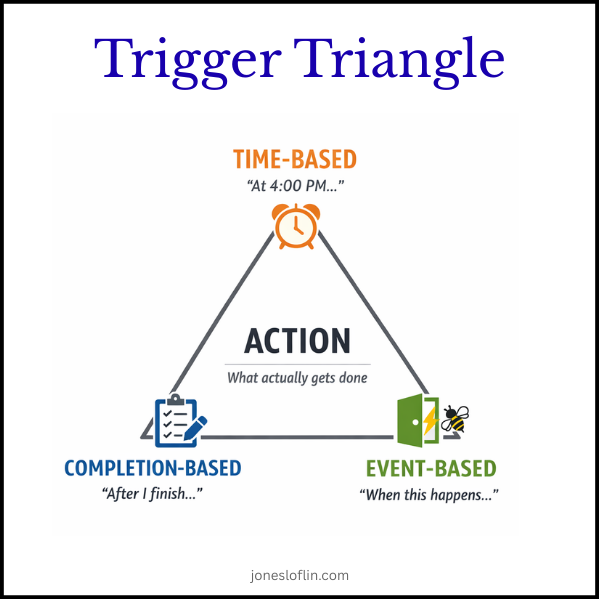
To help you visualize the routines you’re trying to be more consistent with, I created a Trigger Triangle.

When you look at it, ask yourself:
Which routines work best with time-based triggers?
Which ones truly fit completion-based triggers?
Which ones would stick immediately if they were tied to event-based triggers?
I’ll give a few examples from my life:
When I pour my first cup of coffee, I plan my day—or do my 15 push-ups.
When I close my laptop, I stop thinking about work until tomorrow.
When I walk into the living room after work, I put my phone away.
(Notice the keyword is When?)
Consistency Isn’t About Trying Harder
It’s about triggering smarter.
When routines don’t stick, we often blame ourselves. But more often than not, the issue isn’t discipline—it’s design.
Which routine would stick immediately if you attached it to a clear event instead of a feeling?