Why "when I get caught up" never arrives, and what to do instead.
The Key Point
It's easy to put off what matters most until we finally "get caught up." But the to-do list never empties, because life keeps pouring in more. In this post, I'll share why waiting to get caught up keeps us stuck, plus three ways to start making room for what's important right now: name it, shrink it, and schedule it first.
You may not be able to empty the bucket, but you can fill your cup.
Why can't I ever get caught up?
Picture a bucket. That bucket is your to-do list: everything you want to get done today, this week, maybe even in your lifetime. Now picture a spigot above it, pouring water in nonstop. That water is everything that happens every day: the commitments, the responsibilities, the emails, the meetings, the things that just show up.
Most of us have a plan for this. "Once I get caught up," we tell ourselves, "I'll finally have room for the things that really matter." So we grab a scoop and start bailing.
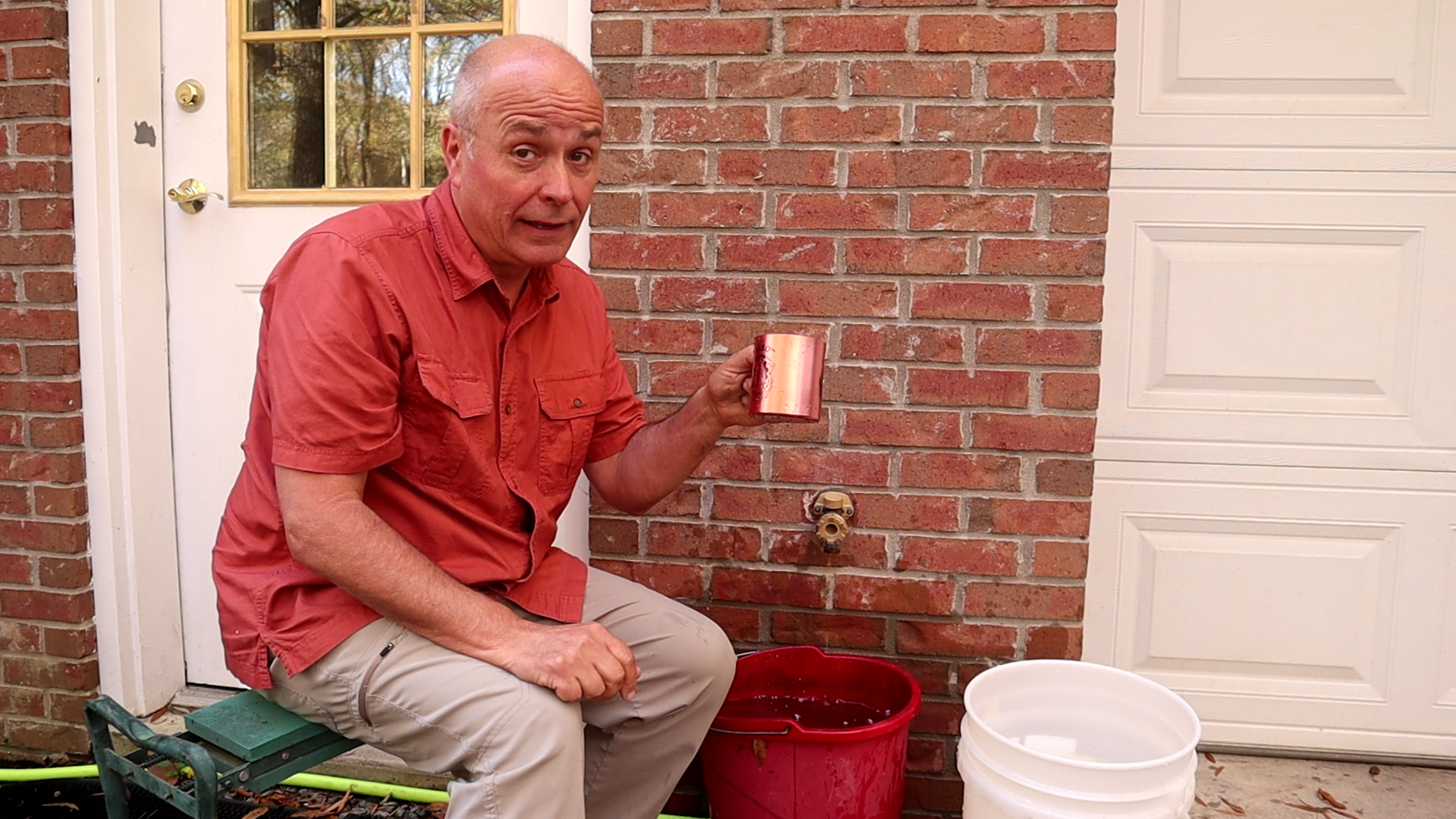
Try it for a minute and you'll see the problem. While you're scooping water out, more keeps pouring in. You're working hard, but the water level barely moves. If you’d like to see my attempts to clear my bucket, check out my Jones Zone video.
And the spigot isn't slowing down. Microsoft's 2025 Work Trend Index found that the average employee using Microsoft 365 is interrupted by a meeting, email, or notification every two minutes, about 275 times a day. The same research found that 1 in 3 employees say the pace of work over the past five years makes it impossible to keep up.
That's the trap of when I get caught up. We imagine we can turn off the spigot, empty the bucket, and magically find space for our most important work. But the spigot never shuts off. Life keeps coming.
The spigot never shuts off. Life keeps coming: interruptions every 2 minutes = 275 times a day.
Here's the sad part. While we're busy scooping, we're missing opportunities right now. Maybe it's a bigger project at work. Maybe it's investing more intentionally in the relationships that matter. Maybe it's time for ourselves, or the things we can only do in this particular season of life.
Are you stuck in "when I get caught up"?
You might be if:
You've said "when things slow down" about the same goal more than once this month.
You only feel allowed to work on what matters after the inbox is clear.
Your "someday" list is longer than it was a year ago.
You can name a person you keep meaning to call, but haven't.
If any of those sound familiar, here are three ways to break the cycle.
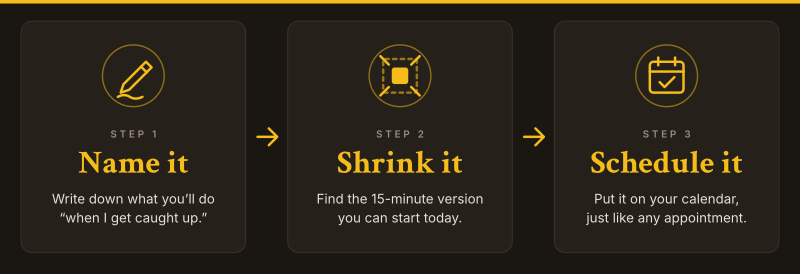
1. Name it
Finish the sentence: "When I get caught up, I will..." Then write it down and capture it somewhere you'll see it.
Go a step further. Describe what it would actually look like if you were doing that thing, and note the resources you'd need to make it happen. When our intentions stay vague, we rarely act on them. Naming it turns a fuzzy someday into something real.
Naming it turns a fuzzy someday into something real.
There's solid research behind this. Behavioral scientists call these if-then plans: you decide ahead of time exactly when, where, and how you'll act, instead of waiting until you feel like you have time. A 2024 review of 642 separate tests found that making these plans helped people follow through, not only on actions but on managing their thoughts and feelings too.
Wharton professor Katy Milkman, author of How to Change, makes the same point to leaders: deciding in advance when and where you'll act can make a big difference in whether you actually do it.
Try it: turn your sentence into an if-then plan.
Vague: "When I get caught up, I'll start mentoring someone on my team."
Named: "When our Thursday team meeting ends, I'll ask Maria what skill she most wants to build this year."
2. Shrink it
One big reason we keep waiting is that we're holding out for a magical big chunk of free time. It never shows up, because life keeps pouring in.
Instead make the goal smaller. Want to start an exercise routine that would take an hour? Ask yourself, "What could I do in 15 minutes?" Want to reconnect with someone but can't find a night for dinner? Start with a text or a quick phone call.
Small isn't the same as pointless. Two studies make the case:
Small bursts of movement count. A University of Sydney study published in Nature Medicine, tracked more than 25,000 adults who didn't exercise. Those who did three or four short bursts of vigorous everyday activity a day, like taking the stairs fast or power walking, lasting about a minute or two each, had about a 40% lower risk of early death than those who did none.
A quick text means more than you think. In a series of studies with nearly 6,000 people, published in the Journal of Personality and Social Psychology, researchers found that people consistently underestimate how much others appreciate a simple, unexpected call, text, or email just to say hello. The more surprising the message, the more it was appreciated.
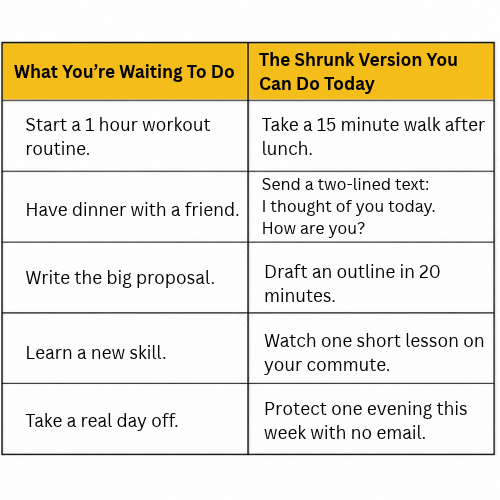
What small steps can you take today toward the things you've been saving for "when I get caught up"?
3. Schedule it first
Those important things aren't happening because we keep waiting for an empty bucket to drop them into. As we've seen, that rarely happens.
It doesn't have to be the very first thing in your day. But put it on your calendar the same way you would any other task or appointment.
A few ways to make the appointment stick:
Give it a real name. "Call Dad" beats "personal time."
Book the shrunk version. A 15-minute block is much easier to protect than a two-hour one.
Guard the spigot during that block. With interruptions coming every two minutes, silence notifications and close your inbox until the block is done.
Treat a miss like a reschedule, not a failure. If it gets bumped, move it. Don't delete it.
You may be amazed, especially once you've shrunk it, at how easy it is to start doing the things you thought had to wait.
Try this week: your 3-minute plan
Take three minutes and fill in these three lines:
Name it: When I get caught up, I will ________________.
Shrink it: The 15-minute version of that is ________________.
Schedule it: I'll do it on ______ at ______.
The big idea
You may never be able to empty the bucket. But you can fill your cup with what helps you manage your time better.
Stop waiting to get caught up. Name it, shrink it, schedule it, and start today.