Role Ambiguity Is Silently Destroying Your Productivity

Key Point
The biggest stressor at work isn't your workload, your boss, or your deadlines. Research spanning 60 years and 800,000 workers points to something far more surprising… role ambiguity.
What 60 years of research reveals about workplace stress
Ask someone what's stressing them out most at work, and you'll probably hear about deadlines, difficult coworkers, or an impossible workload. What you're unlikely to hear, but far more likely to be true, is:
"I honestly don't know what I'm supposed to be doing."
Most people won't say that out loud. But the research tells a different story.
A sweeping meta-analysis published in the Journal of Vocational Behavior drew on 515 peer-reviewed studies and dissertations spanning six full decades, analyzing data from nearly 800,000 workers. The study stands as one of the most comprehensive investigations of workplace stress ever conducted.
The researchers examined three classic workplace stressors:
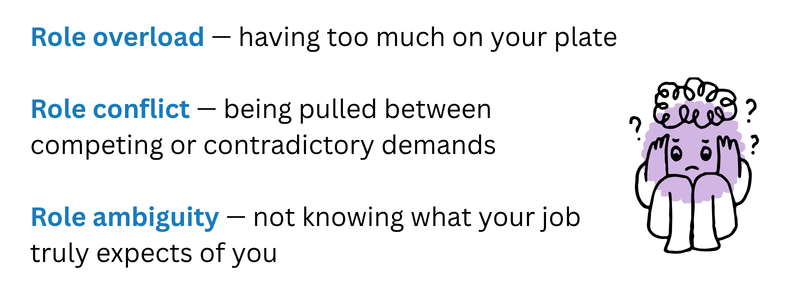
Role ambiguity won, and it wasn't even close. Across every measure the researchers tracked; stress, productivity, burnout, and intent to quit, unclear expectations were the single most damaging workplace stressor. Not across one industry or one generation. Across six decades of data, spanning massive shifts in culture, technology, and the nature of work itself.
If you find yourself going through the motions without a clear sense of direction, this isn't a personal failure. It's one of the most common and well-documented challenges in the modern workplace.
Why role ambiguity hurts more than you realize
Beyond the stress itself, role ambiguity has a direct impact on performance. When people don't know what winning looks like, they can't consistently play to win.

This connects to something I've seen repeatedly in my work with organizations ranging from FedEx and Walmart to the United States military: the teams that thrive aren't necessarily the ones with the most resources or talent. They're the ones where people wake up each morning knowing exactly what their most important work is.
In Focused As A Bee, I explore how honeybees offer a surprisingly powerful model for human productivity. A honeybee never wonders what their job is. They do not drift toward work that isn't theirs to do. The hive succeeds not because every bee does everything, but because every bee does the right thing at the right time.
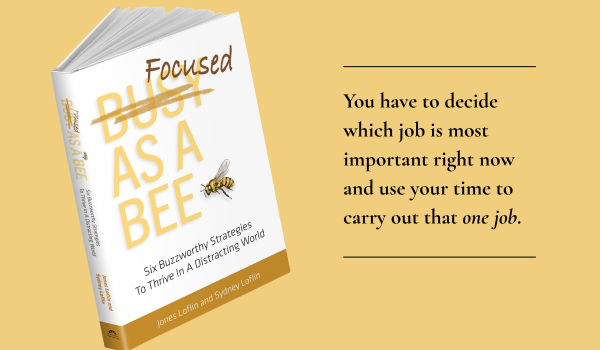
That's role clarity in its purest form. And it's available to every one of us, if we're willing to ask the right questions.
3 ways to reduce role ambiguity
You don't have to wait for a major organizational overhaul to feel clearer about your role. These three actions can create meaningful change right now.
1. Ask what success looks like
Find someone you report to and ask them directly: "What does success look like in this role? If someone were performing at their peak, what would they be doing?" This single question can surface expectations that have never been explicitly stated. Take notes. You may be surprised by what you learn and how much it clarifies your path forward.
You can't hit a target you've never been shown.
2. Identify your top three priorities and confirm them
Write down what you believe your top priorities should be. Then don't assume. Check with someone. Confirm that your focus aligns with what the organization actually needs from you right now.
Clarity isn't something that happens to you. It's something you pursue.
3. Get clear on decision boundaries
Role ambiguity often lives in the gray area of decision-making. Which calls are yours to make? Which ones require input or approval? Mapping this out and asking when you're unsure, removes one of the most frustrating and draining sources of uncertainty at work.
Knowing where your authority ends is just as important as knowing where it begins.
A question every leader should ask their team
If you manage people, there's a powerful question worth putting in front of each person on your team:

Then listen. Low scores don't reflect poor leadership, they reflect an opportunity. In Always Growing, I use the analogy of a gardener to describe what effective leaders actually do: they prepare the soil, remove what's blocking growth, and create the environment where their people can thrive.
Role clarity is foundational to that kind of environment.
The bottom line: clarity protects energy
Six decades of research make one thing unmistakably clear: when people don't know what's expected of them, they suffer and so does their work.
But clarity isn't just about reducing stress. It's about protecting your energy and directing it toward what actually matters. When you know what success looks like in your role, you stop wasting effort on the wrong things. You make better decisions. You build momentum.
That's not just good for you. It's good for everyone around you.
If you're nodding along right now thinking, "Yeah, that's me", you already know what to do next.
Ask the question. Confirm the priority. Define the decision.
Clarity is one conversation away.